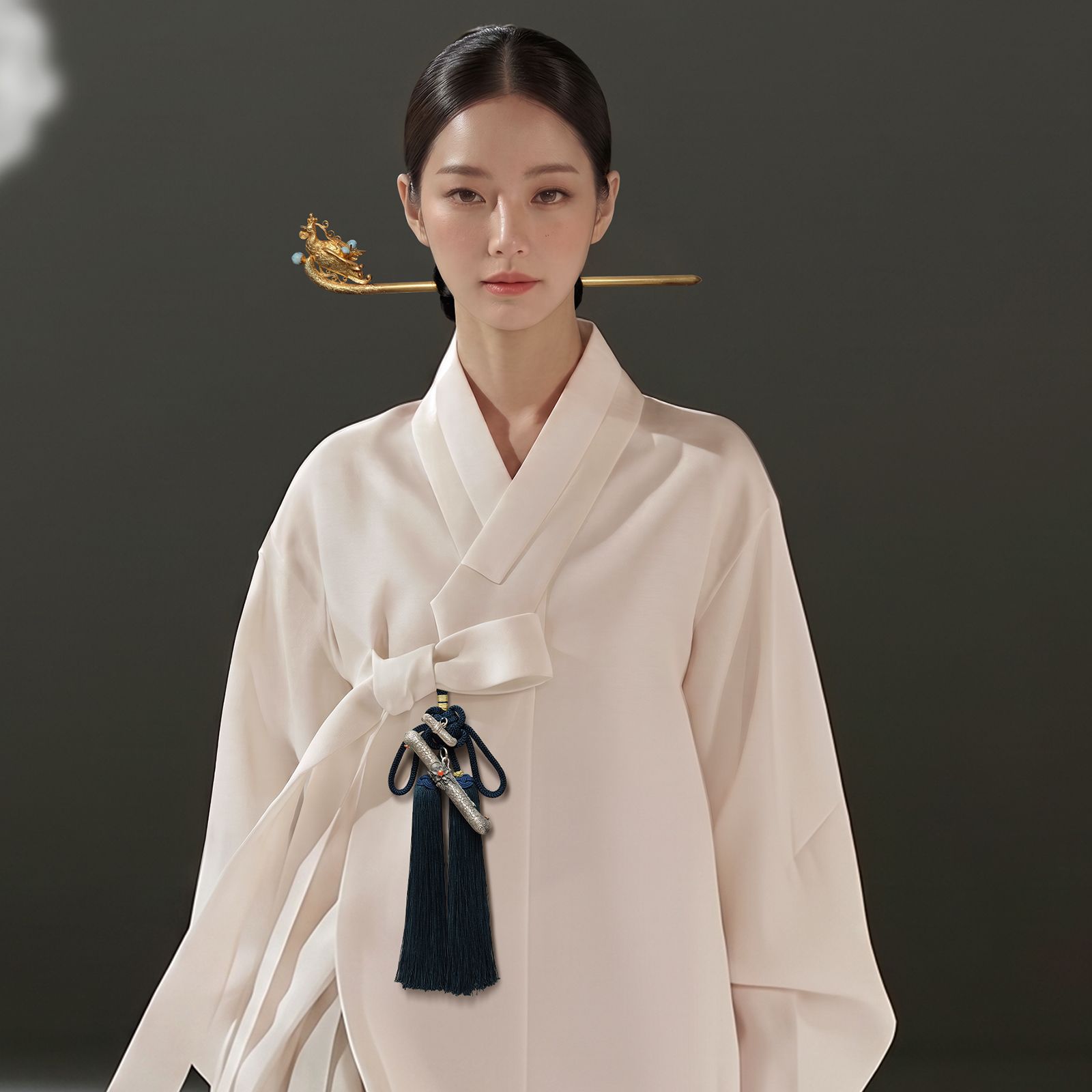
All jokduri share one structure. What changes is the ornament — and the occasion.
Parts of a jokduri
- Body 몸체 — six panels sewn over a padded, stiffened form; broad at the top, narrower at the base, hollow inside. Traditionally black silk outside, cotton within.
- Okpan 옥판 — a jade plate set at the center of the top, often carved as a flower or leaf. It supports the finial.
- Finial — a vertical stack of beads or a carved form rising from the okpan: coral, amber, pearl, jade.
- Bead strings — short strings of coral, amber and pearl crossing or circling the top.
- Side ornaments — carved jade, stone or metal medallions on the faces of the crown.
- Gwonja 권자 — historically, a small gold or jade ring ornament showing the husband's rank.
By use
Kkumin-jokduri 꾸민족두리 · decorated
The wedding jokduri. A jade plate at the center of the top, strung with coral, amber and pearls. The form most people picture.
Chilbo-jokduri 칠보족두리 · jeweled
Decorated with enamel (chilbo) and jeweled ornaments. The richest bridal form, recorded in court use.
Min-jokduri 민족두리 · plain
Without ornament. Worn for ancestral rites, where display was out of place.
Huin-jokduri 흰족두리 · white
For mourning dress.
Eoyeom-jokduri 어염족두리 · base
A black silk pad, filled with cotton and pinched at the waist, used as the foundation for the large court wigs called eoyeomeori and tteoguji. Not worn on its own.
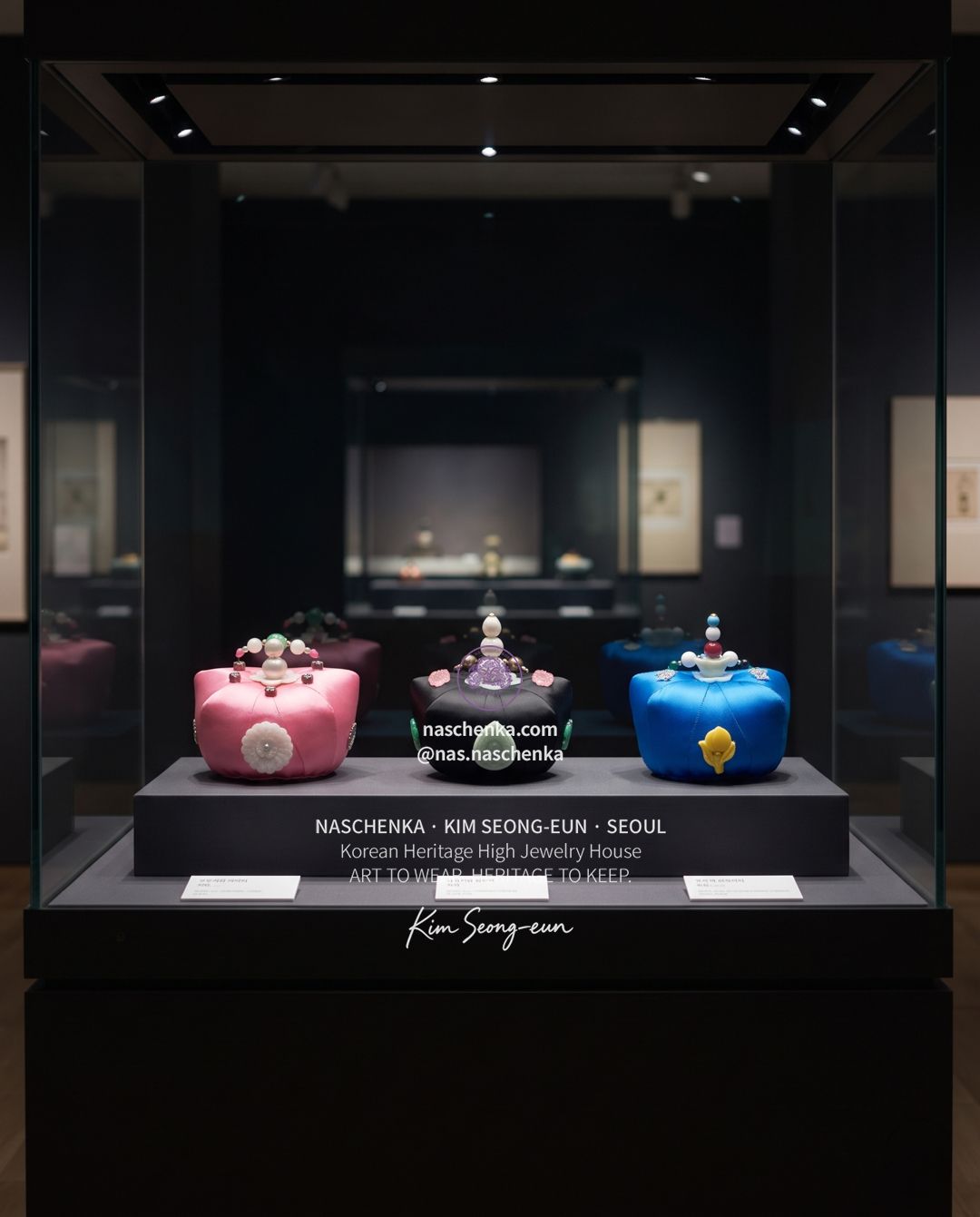
Color
Traditional jokduri are black silk. Contemporary jokduri also appear in colors chosen to suit the hanbok — blue, pink, ivory — while keeping the six-sided form and the jeweled top.
Jokduri and hwagwan
| Jokduri 족두리 | Hwagwan 화관 | |
|---|---|---|
| Form | Compact six-sided crown | Open flower crown |
| Character | Architectural, restrained | Floral, theatrical |
| Worn by | Brides; women in formal dress | Brides; court dancers |
| Ornament | Jade plate, bead finial, medallions | Flowers, beads, metal ornaments |
References
- Encyclopedia of Korean Culture (한국민족문화대백과사전), “족두리,” Academy of Korean Studies. encykorea.aks.ac.kr
- National Research Foundation of Korea, Dictionary of Korean Costume (한국복식사전), “족두리,” via Academy of Korean Studies Digital Humanities. dh.aks.ac.kr
- Goryeosa (高麗史), vol. 89, Biographies 2, Royal Consorts: Sukchangwon-bi Kim and Sun-bi Heo.
- Kim Ji-yeon, “A Study on the Jokduri,” MA thesis, Ewha Womans University, 1999. dspace.ewha.ac.kr
- Lee Gap-hee, “족두리 소고,” MA thesis, Ewha Womans University, 1976. dspace.ewha.ac.kr
- “A Study on Headdresses for Ceremony in the Latter Period of Chosun — Focusing on Jokduri and Hwagwan,” Korean Journal of Human Ecology 5(2), 2002.
- Yi Gyu-gyeong, Oju yeonmun jangjeon sango; Yi Deok-mu, Cheongjanggwan jeonseo; Choe Nam-seon, Gosatong.