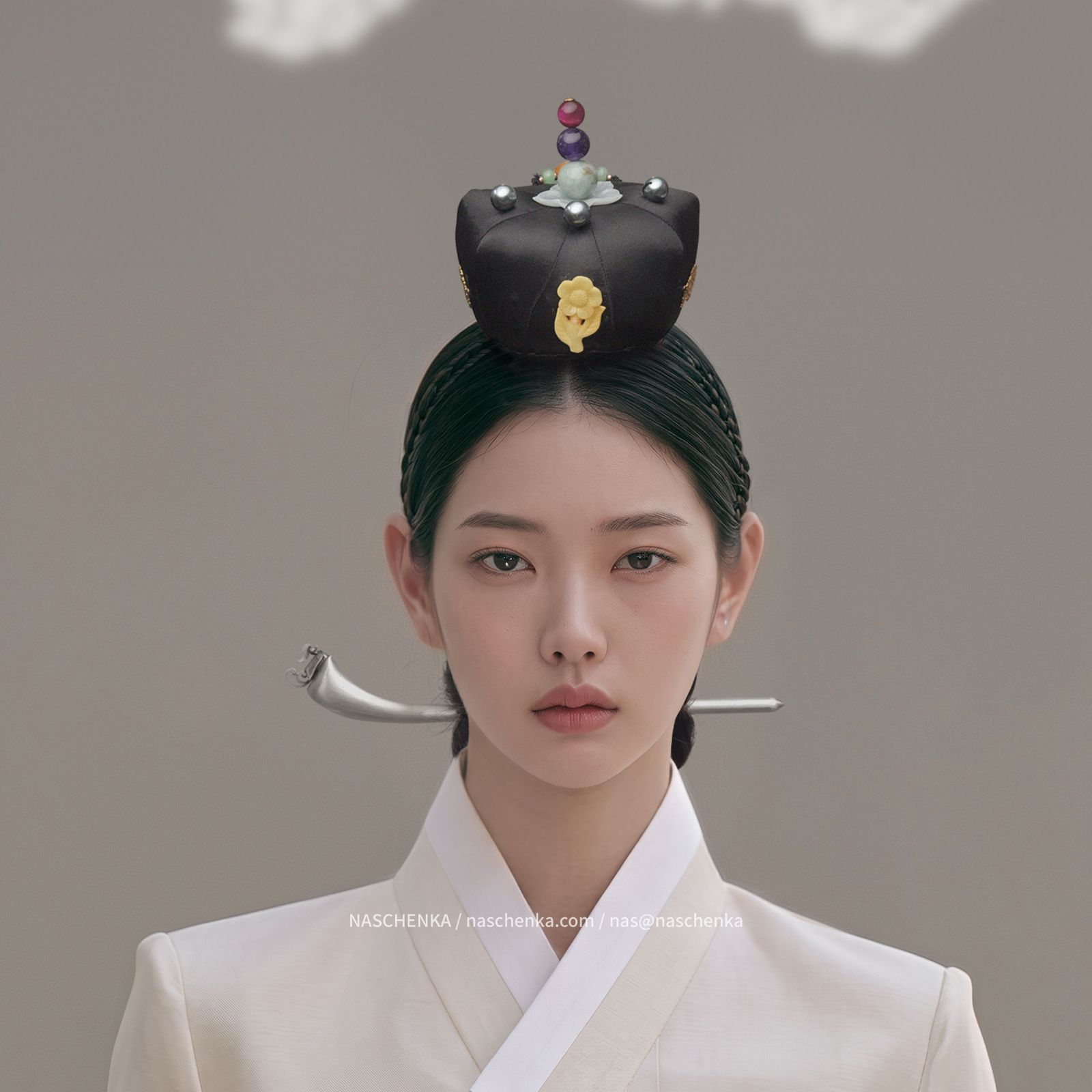
The jokduri traveled a long way. It began as the towering headdress of Mongol noblewomen, came to Korea through royal marriage, shrank, changed, and became the most Korean of bridal crowns.
The boqtaq of the steppe
Mongol noblewomen of the twelfth and thirteenth centuries wore a tall headdress, the boqtaq. Chinese writers spelled its name many ways — gugu, gogo and others — a sign it was a loanword. One thirteenth-century Chinese travel account explained that it was named for its tip, which looked like a goose or a duck.
Goryeo: a gift from the Yuan court
From the late thirteenth century Goryeo kings married Yuan princesses, and Yuan court ways entered the Goryeo palace. The Goryeosa (History of Goryeo), volume 89, records that the Yuan empress dowager sent envoys bearing a gogo for two Goryeo royal consorts, Lady Kim (Sukchangwon-bi) and Lady Heo (Sun-bi). The court celebrated; officials brought gifts; and Lady Kim wore the gogo herself to entertain the envoys. The Goryeo jokduri is thought to have been larger and taller than the Joseon one.
The name
The word jokduri is usually explained as a corruption of gogori (古古里), the Yuan headdress given to Goryeo queens. Joseon scholars — Yi Deok-mu in the Cheongjanggwan jeonseo, Yi Gyu-gyeong in the Oju yeonmun jangjeon sango — and, later, Choe Nam-seon in the Gosatong all describe it as a Mongol-derived custom. In Chinese characters it was written 簇頭里, and it was also called jokdu (簇兜) or jokgwan (簇冠).
Early and mid Joseon
In the first centuries of Joseon, formal women's hair meant volume. Women of rank built their hair high with gache, wigs of added hair, and the jokduri played a smaller part.
The wig bans
By the eighteenth century the gache had become a social problem: wigs cost as much as a house, and families went into debt for a bride. King Yeongjo and King Jeongjo moved to ban it, ordering women to wear their own hair in a chignon and to use the jokduri in place of the wig. Late-Joseon writers discussed the jokduri and the hwagwan precisely as remedies for the extravagance of the gache.
The bride's crown
After the bans the jokduri became general. By the end of Joseon it was worn with wedding dress even by commoners, and noble households treated it as essential to formal dress. Some scholars objected that it was a foreign custom; the jokduri stayed. Its uses multiplied: the decorated jokduri for weddings, the plain jokduri for ancestral rites, a white jokduri for mourning, and a padded base under the court's ceremonial wigs.
The twentieth century and today
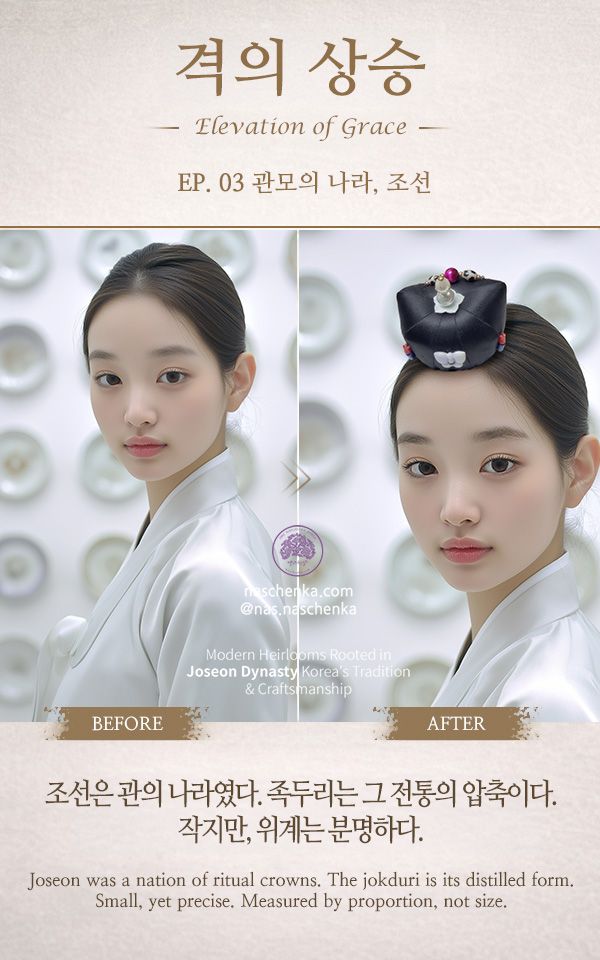
As Western weddings arrived, the jokduri moved to the traditional ceremony: the pyebaek, in which the bride greets her husband's family. It survived in dance, in historical drama and in portraits. Today it is being worn again as a jewel in its own right — on screen, on the runway and, at NASCHENKA, in collections designed to be kept.
12th–13th c. Mongol noblewomen's boqtaq / gugu headdress
Late 13th c. Goryeo–Yuan royal marriages; a gogo sent to Goryeo consorts
Goryeo A larger, taller jokduri at court
18th c. Kings Yeongjo and Jeongjo ban the gache wig; the jokduri replaces it
Late Joseon Jokduri worn by brides of every class
2011 NASCHENKA reinterprets the jokduri as a tiara
2026 NASCHENKA jokduri in the drama Perfect Crown
References
- Encyclopedia of Korean Culture (한국민족문화대백과사전), “족두리,” Academy of Korean Studies. encykorea.aks.ac.kr
- National Research Foundation of Korea, Dictionary of Korean Costume (한국복식사전), “족두리,” via Academy of Korean Studies Digital Humanities. dh.aks.ac.kr
- Goryeosa (高麗史), vol. 89, Biographies 2, Royal Consorts: Sukchangwon-bi Kim and Sun-bi Heo.
- Kim Ji-yeon, “A Study on the Jokduri,” MA thesis, Ewha Womans University, 1999. dspace.ewha.ac.kr
- Lee Gap-hee, “족두리 소고,” MA thesis, Ewha Womans University, 1976. dspace.ewha.ac.kr
- “A Study on Headdresses for Ceremony in the Latter Period of Chosun — Focusing on Jokduri and Hwagwan,” Korean Journal of Human Ecology 5(2), 2002.
- Yi Gyu-gyeong, Oju yeonmun jangjeon sango; Yi Deok-mu, Cheongjanggwan jeonseo; Choe Nam-seon, Gosatong.